
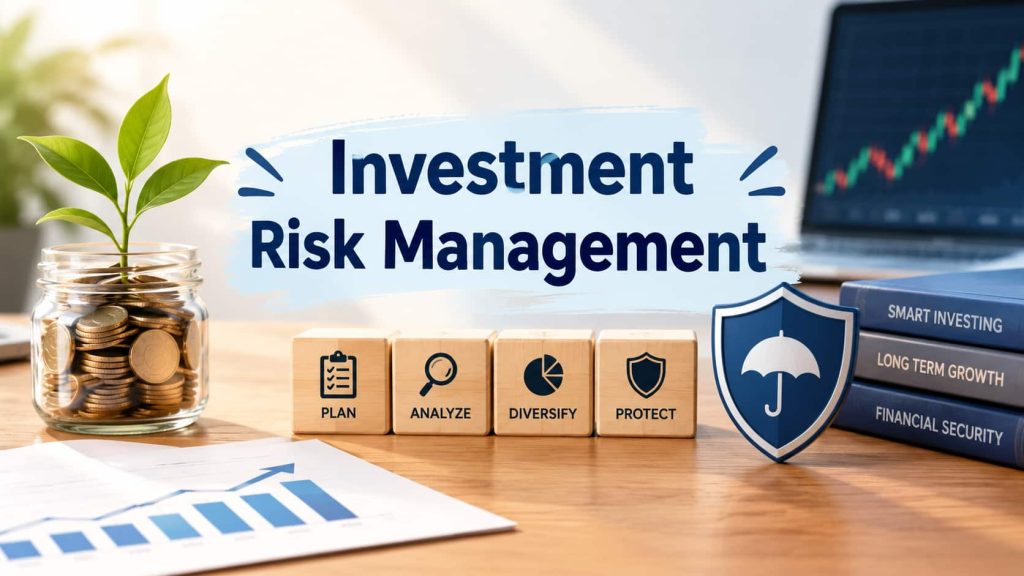
Investment Risk Management helps investors handle market uncertainty, limit potential losses, and make informed choices without taking unnecessary risks.
Have you been concerned that your hard earned money could be lost in one poor investment? While returns are important to many investors, they don’t think about the risks involved with their investments. Investment Risk Management teaches you how to identify potential loss areas and to be ready for investment losses. With some practice, you can learn how to deal with uncertainty, preserve your money and make better decisions about investing.
Investment Risk Management
Investment Risk Management is the procedure of recognizing and managing risks that can impact your investments. Uncertainty comes with every asset, whether it’s stocks and ETFs, bonds or property. It’s not to eliminate risk altogether, but to manage it.
This includes selecting the right combination of assets, diversification, having some cash on hand, and rebalancing your portfolio. An appropriate plan can also minimize emotional choices in the event of market fluctuations, and permit you to focus on your own financial goals.
go and check also: Saving vs investing
Why is investment risk management important?
If you’re investing without a clear risk plan, you could lose your investment and it may be hard to get your money back. Investment Risk Management allows you to become familiar with these risks before they impact your portfolio, and enables you to make more well-rounded investments.
Safeguards your investment: Ensures you aren’t vulnerable to losing a lot of money.
Helps with better decisions: Provides clarity on making investment decisions rather than basing it on hype.
Manages strong emotions: Aids in preventing panic selling in the event of a sudden drop in prices.
Improves portfolio balance: Promotes diversification in the portfolio.
Works on long-term goals: Maintains consistency of your investment decisions with your investment plans and time frame.
Common Investment Risks You Should Know
Market Risk: Share or fund prices may decrease due to economic changes, market sentiment or unforeseen events.
Inflation Risk: Over time, prices may increase which may decrease the value of the returns you earn from your investment.
Interest Rate Risk: When interest rates change, bonds, stocks and other interest-sensitive assets can be impacted by the change.
Liquidity Risk: There can be investments that may be hard to sell the asset quickly without taking a discount.
Credit Risk: A borrower or an issuer may default on its payment of interest and/or principal.
Concentration Risk: If too many resources are placed in a single asset, company, sector or market, there is a higher risk of losses.
Exchange Risk: Foreign investments could lose value due to exchange changes that work unfavorably.
Example of a simple investment risk management.
Suppose an investor had $20,000 available with which to invest for the long term. They don’t invest all their money in one stock, they create a more balanced portfolio.
- This plant will grow $10,000 worth of stock.This plant will create $10,000 worth of stock.
- The bonds that came in would be $5,000 for greater stability.
- Diversified ETFs for exposure to the overall market (total of $3,000)
- Cash emergency fund of $2,000 for emergencies and flexibility
When one stock or sector goes down, the other stocks or sectors don’t necessarily pull down the rest of your portfolio. The investor can check the allocation periodically and tweak it as needed when it deviates from the original plan.
With this simple example, we can see how Investment Risk Management can help reduce overexposure and yet have room for growth. The exact mix will always depend on an investor’s goals, time and money.
How to Assess Your Investment Risk
Consider Your Risk Tolerance
Consider your ability to deal with fluctuations in the market. If you’re panicked when you experience a short-term loss, you may not want to have a high-risk portfolio.
Discuss Your Risk with your adviser
Risk tolerance is a matter of comfort and risk capacity is a matter of how much risk you can financially take. Any income, savings, debt and emergency funds apply.
Take a look at Your Investment Timeline.
The amount of risk that you can tolerate may vary depending on your time horizon. Having long-term objectives might give more time to weather short-term market declines.
Align risk with your financial goals
Investments should be made based on a long-term plan such as retirement, home ownership, long-term wealth building, etc. Different levels of return and/or risk are possible for each goal.
Assess your present financial situation
Take your income, savings, previous investments and debts into consideration before taking on additional risk. When a good investment foundation is established, Investment Risk Management is less challenging.
6 Practical Ways to Manage Investment Risk
1. Diversify Your Investments
- Spread your investments across a range of assets, industries or companies.
- Don’t invest too heavily in any one investment.
- As an illustration, a poor-performing asset can be balanced out by diversification.
- Choose a right-asset mix
2. Choose a “Suitable Asset Allocation.”
- If suitable, invest in stocks, bonds, ETFs, cash and other investment categories.Spread out your investments across stocks, bonds, ETFs, cash and other investments if appropriate.
- Take into account your objectives, schedule and budget.
- Adjust the ratio as circumstances change.
3. Don’t exceed the level of exposure to One Investment.
- Look to see if one holding is too large of a proportion of your portfolio.
- Exercise caution if one particular asset is appreciating.
- Rebalancing can aid to maintain levels of exposure.
4. Be sure to keep an Emergency Cash Reserve
- Have easy access to savings for emergencies.
- Avoid making a quick sale of investments to make immediate cash.
- Having cash to cushion the blow of a market downturn.
- Check Your Portfolio From Time to Time
- Don’t check your investments too frequently.
- Be aware of risk, allocation and financial goal adjustments.
- Re-balance when the mix is too far away from the desired proportions.
6. Concentrate on Your Long-Term Plan
- Don’t make hasty choices in times of market instability.
- Stay on track with investments and financial objectives.
- Leave appropriate investments to ride out fluctuations in the short-term.
Diversification vs Asset Allocation?
| Aspect | Diversification | Asset Allocation |
| Meaning | Spreading investments across various assets, companies, or sectors. | Identifying asset classes to invest in and deciding how much to allocate to each. |
| Main Purpose | Minimize the impact of a weak-performing investment. | Create a portfolio that matches your risk tolerance and financial goals. |
| Focus | Spread of investments within and across different areas. | Overall portfolio structure. |
| Example | Investing across technology, healthcare, and energy sectors. | Allocating 60% to stocks, 30% to bonds, and 10% to cash. |
| Risk Management Role | Spreads risk across different investments. | Controls the level of risk within the overall portfolio. |
| How It Changes | May involve adding different companies, industries, or assets. | Can change as your goals, timeline, or risk tolerance changes. |
What’s Your Investment Risk Level?
There are different levels of risk among investors. This amount will be different for everyone depending on their financial situation, objectives and expectations, timeframe and risk tolerance.
Conservative investors: These are likely to be more risk averse and be holding onto a greater portion of their assets in lower-risk investments.
Moderate investors: Typically invest in growth and more conservative investments to moderate risk and return.
Aggressive investors: Will be okay with more price fluctuation.
Think of the time frame: perhaps you have a long time horizon and can ride out the short-term ups and downs.
strategy should be adjusted to the objective: A retirement account may call for a different strategy than the money set aside for a short-term objective.
Assess your finances: Even if it sounds like a great investment, do not invest more money than you can afford.
Final Thoughts
Investment Risk Management is not a way to prevent all loss. It’s all about awareness of what you are exposed to and then choosing accordingly with your financial options. Unnecessary risks can be kept under control through diversification, proper asset allocation, periodic review and a long-term plan.
Successful investing requires not going with the trends. It’s better to strike a balance between growth and risk that you can withstand.
FAQs
Q1- How can risk management help to boost investment returns?
Not directly. It primarily helps you avoid needless losses, and maintains a level investment strategy.
Q2- Should people withdraw investments at the time of fluctuations in the market?
Not always. Try not to make hasty decisions; also determine if your portfolio has changed from the original plan.
Q3- Is risk management applied to short-term investments?
Yes. Market risks, inflation risks and liquidity risks are also applicable to short-term investments.
Q4-What are the possible ways technology can be used to manage investment risk?
Yes. Portfolio tools can be used to manage allocation, performance and exposure.
Q5- Does holding cash have no risk to it at all?
There are relatively few market risks to cash, but with time inflation can reduce its buying power.

Pingback: Investment Options in The US: Wise Ways to Invest in 2026