
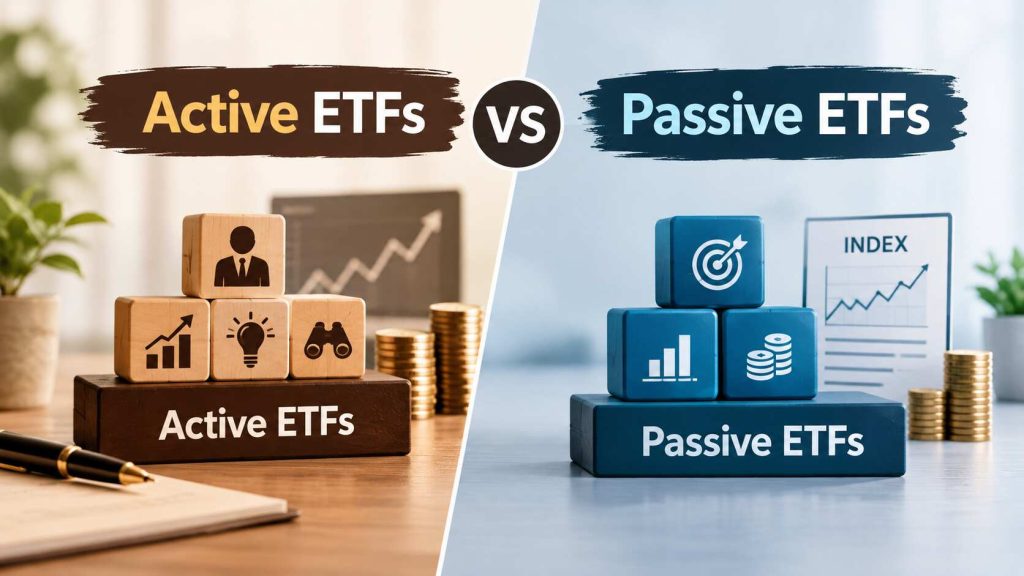
Active ETFs vs Passive ETFs explained through fees, management, risks, and returns. See how both approaches work and what sets them apart before investing.
Stuck between the choices of an active ETF or passive ETF? It’s not just a matter of the way the fund is managed. There are differences between the two in terms of fees, flexibility, risks and performance. These Active ETFs vs Passive ETFs can help to demystify investing in ETFs. Let’s see how both of these work and what makes them different when it comes to investing in ETFs.
What are Active ETFs?
Active ETFs are ETFs run by investment professionals. Managers won’t just follow an index; they can select, include and exclude holdings based on a fund’s strategy.
They are flexible with the portfolio, depending on the market. This will provide more flexibility for active ETFs than funds that closely follow a fixed index.
Their business plans can be growth, income, certain industries, or some other investment objective.
What are Passive ETFs?
Passive ETFs are exchange-traded funds that track a particular index or benchmark. The fund will try to do a “copying” of the index it tracks, in contrast to the frequent picking done by the manager of individual investments.
The ETF could effect changes in its holdings if the index changes. This can generally be done with fewer trades, which can lead to reduced management expenses.
A passive ETF may be used to gain exposure to a wide market or industry or even a particular group of assets with one purchase.
Go and check aslo: Stock Research Tools 2026
Active ETFs vs Passive ETFs: Key Differences
| Factor | Active ETFs | Passive ETFs |
| Management | Run by investment professionals | Typically follows an index |
| Investment Decisions | Holdings can be changed by the manager | Holdings generally follow the benchmark |
| Flexibility | Greater ability to realign the portfolio | Changes mainly occur when the tracked index changes |
| Main Goal | Seek returns based on an active strategy | Track the performance of an index |
| Costs | Usually require more management and may cost more | Tend to have lower costs |
| Trading Activity | May involve more frequent portfolio changes | Typically involves fewer changes |
| Performance | Partly depends on management decisions | Closely related to the performance of the tracked index |
| Risk Factors | Market risk plus manager and strategy risk | Market risk plus tracking risk |
How Management Strategies Impact on ETF Performance
- Active decision making: This means that managers are able to make decisions regarding holdings as per market conditions and fund strategy.
- Index tracking: Passive ETFs seek to closely track the index they are designed to match.
- Changes to the portfolio: Active funds might make more frequent changes to their portfolio than passive funds.
- Market response: The way a marketplace responds to market conditions can vary depending on the management style.
- Fees and tracking: Tracking and fees vary can also impact the returns.
Active ETFs vs Passive ETFs Costs
| Cost Factor | Active ETFs | Passive ETFs |
| Expense Ratio | Often higher | Often lower |
| Management Fees | Tend to be higher due to active management | Generally lower |
| Trading Costs | May be higher when portfolio changes are frequent | Usually lower due to fewer changes |
| Fund Expenses | Can vary based on the fund’s strategy | Often more predictable |
| Long-Term Cost Impact | Higher fees can reduce returns over time | Lower fees can help reduce ongoing expenses |
What are the differences between Risk and Flexibility?
Risk and flexibility may vary from one EFT to another, depending on the way that they are managed.
Portfolio flexibility: Active ETFs can rebalance their portfolios based on market dynamics.
Index dependence: Passive ETFs are very closely linked to their underlying index.
Manager risk: The decisions and strategy of the fund managers are a key component of active funds.
Tracking risk: There are several reasons why tracking risk may not be 100% accurate for passive funds.
Market exposure: The same applies to both types, that they are vulnerable to the risks of the assets they have in the market.
When Do Investors Consider Active ETFs?
Investors who seek a fund that is more flexible may find active ETFs attractive. They have flexibility in managing their holdings rather than being locked in to one specific index.
You can invest in Active ETFs for:
- Changing Markets: Managers can adjust holdings when there is a change in market conditions.
- Specific Themes: There are some funds that focus on a specific theme, like technology, income, growth or specific industry.
- More flexible: The portfolio may be modified during the time of the strategy change in the fund.
- Investor’s Trust: Some investors like to have professional managers make decisions about their investments every day.
When Do Investors Consider Passive ETFs?
For those who aren’t interested in actively managing their investments, passive ETFs might be a better fit. They can offer market exposure without having to make frequent portfolio decisions.
Broad Market Exposure
One ETF will provide exposure to numerous companies in an index.
Lower Ongoing Costs
Passive ETFs are generally lower cost than active ETFs, since they are passive and follow a given index.
Simple Portfolio Structure
When the underlying index is simple, their holdings are normally easier to comprehend.
Long-Term Approach
Passive ETFs are sometimes incorporated into a long-term investment portfolio that aims for exposure to the overall market.
Active ETFs vs Passive ETFs: How 2026 Is Changing the ETF Market
More Active ETFs vs Passive ETFs in 2026 – particularly for actively managed products. According to Morningstar, the number of active ETFs has expanded quickly and by June 2026 there were over 3,200 active ETFs trading on U.S. exchanges versus approximately 2,100 index-tracking ETFs.
New Active ETFs: Asset managers are launching new actively managed funds in stocks, bonds and niche strategies.
More Strategy Options: Discretionary, systematic, thematic and other investor strategies are now available with ETFs.
In the realm of asset: traditional passive continues to reign supreme, and active ETFs are adding more options.
New ETF Structures: A variety of new and more complex ETFs are also emerging on the market, such as derivative-based and defined-outcome ETFs.
It’s not as easy as it sounds when it comes to distinguishing between active and passive—it’s getting murkier; you need to look at how each fund manages its portfolio.
What Should You Check Before Choosing an ETF?
- Expense Ratio
- Holdings
- Investment Strategy
- Liquidity
- Risk Level
- Diversification
- Past Performance
- Tax Considerations
Final Thoughts
There are two methods to get market exposure: Active ETFs vs Passive ETFs. Active funds provide managers with more flexibility to move assets, passive funds are typically closer to an index.
The key in the right comparison is more than just fees or history of returns. Investors must take into account the strategy, holdings, risk, cost, and goals of the fund prior to considering the fund.
FAQs
Q1. Is an active ETF able to follow an index?
Yes. Some of the active ETFs may be able to use an index as a benchmark and still make investment decisions in other areas.
Q2. Do active ETFs have to disclose their holdings?
The ETFs typically publish information on a periodic basis regarding constituents, though the frequency and amount of disclosure differs among the funds and the rules of the markets.
Q3. Are passive ETFs actively-traded?
Yes. The term passive doesn’t refer to how actively investors buy and sell the ETF, rather it refers to the way the portfolio is managed. Shares may be traded during the day, buying or selling.
Q4. Is it possible for an ETF to go from an active to a passive fund?
The investment objective of a fund may be changed but that depends on the structure of the fund, the prospectus and applicable requirements under the regulations.
Q5. Are the fees charged by all active ETFs higher than those of passive ETFs?
No. As with every fund, costs vary from one investment fund to another, and not every fund offers the same expense ratio.

Pingback: Letsinvest Financial Services: Your 2026 Money Edge
Pingback: How Blockchain Technology Works: Explore 7 Key Insights