
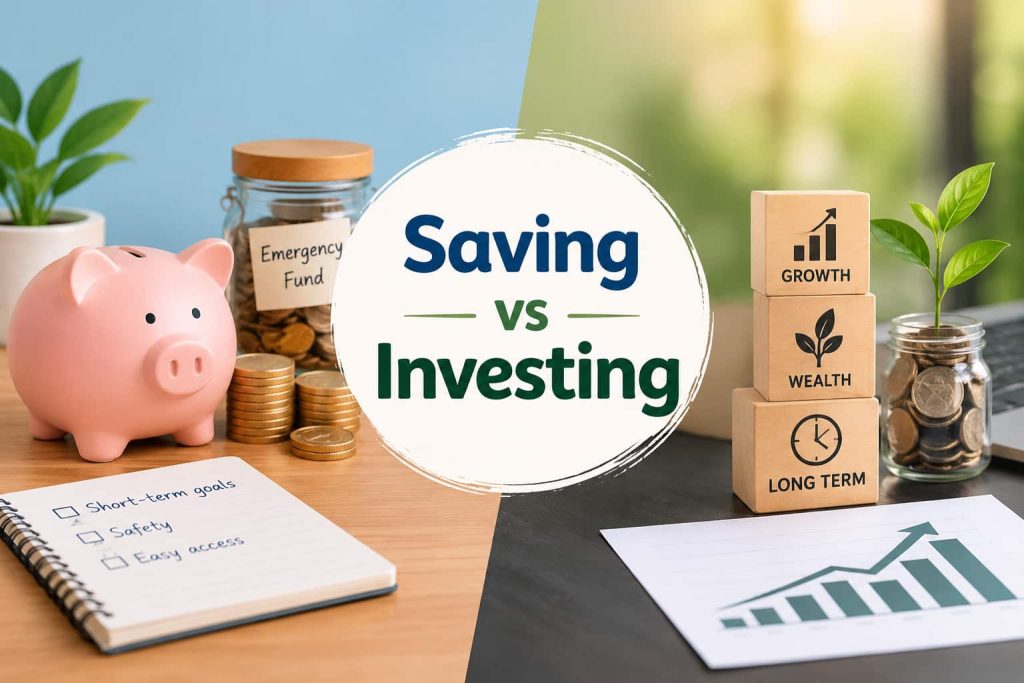
Saving vs investing can shape how you manage money and reach future goals. See the key differences, benefits, and smart ways to choose the right approach.
Need some clarification on whether saving or investing is the best idea for your money? People have been saving consistently, but still not sure how to build up their savings for future use. Still others invest with no knowledge of the risk, and make decisions that are not appropriate to their objectives. The secret to success is the timing of your saving vs investing – and why it can make a difference in your life. Let’s simplify the terms saving vs investing in this article. You will witness the working of each method and how to decide on one in light of your financial objectives.
What Is Saving?
Saving is the opposite of spending and involves saving a part of your income. This fund is typically held in a safe and easily accessible location when needed.
Saving money can be used for your daily expenses, future emergencies or your long term goals, which may be just a few months or years away. Saving in the form of an emergency fund is another typical example of saving.
The primary advantage is access and reliability. Your funds are still accessible without the ups and downs of the market that may impact investments. But savings may not increase at a rate fast enough as investments, particularly if the purchasing power of money decreases with the passage of time due to inflation.
What Is Investing?
Investing is the process of committing funds to an asset which can grow in value or yield a return over a period of time. Invested funds are typically for longer term objectives, as opposed to regular savings.
Individuals can invest in their stocks, mutual funds, bonds, real estate or other financial instruments. There is always a varying degree of risk and return with each option.
It is very easy to understand the main idea. You don’t just save all of your money, but you invest some of it for future use. But prices of investment can go up or down and the choice depends on your investment objectives, time horizon, and tolerance of risk.
Go and check for also: Blockchain technology works
Saving vs Investing – What is the difference?
| Factor | Saving | Investing |
| Main Purpose | Keeps money secure for future needs | Aims to increase money’s value over time |
| Risk Level | Usually lower risk | Risk levels vary by investment |
| Returns | Generally lower | Higher returns are possible, but not guaranteed |
| Time Frame | Short to medium term | Mainly medium to long term |
| Access | Usually easy to access | Access depends on the investment |
| Value Changes | Usually more stable | May rise or fall with the market |
| Best For | Emergencies and short-term goals | Long-term goals and wealth creation |
| Example | Savings account or cash reserve | Company shares, mutual funds, or bon |
When is it a good time to save?
When you might need the money in the near future, saving makes sense. It maintains your money available and shields from the market.
For Emergencies
Unforeseen expenses may come up at any time. Your budget may be impacted by medical expenses, repairs or a loss of income. An emergency fund provides you with cash to deal with this kind of situation.
For Short-Term Goals
Goals that are not in the distant future are good to save. You might need cash for travel or education fees, or perhaps a planned purchase. Having these monies readily available can help make such plans easier to manage.
For Upcoming Expenses
There are certain costs that can be forecast. Planned spending for annual bills, insurance payments and household expenses. Saving regularly helps you to be ready to deal with them within your daily budget.
When You Need Quick Access
There are times when financing requirements can’t be put on hold. Saving allows you to have access to money when you need it. It’s not imperative to rely on the market or to trade an investment at the incorrect moment.
Before Taking Investment Risks
If you have a cash reserve, it can provide you with additional financial flexibility. It can additionally decrease the need to sell investments in a falling market. This helps you to avoid confusing your short-term needs with long-term funds.
When Should You Invest?
Money that can be invested that will not be needed for several years can be suitable for investing. The longer that you have to invest, the more your money has the chance to grow.
For Long-Term Goals
There are goals to be prepared for over a number of years. This can include retirement, home ownership or further education. These plans may be aided by investing over a period of time.
When You Have Emergency Savings
It is easier to invest when you don’t have to worry about such unforeseen expenses. An emergency fund is able to pay for unexpected expenses. Your investments may then be more geared towards longer-term objectives.
When Your Income Is Stable
Consistent investing is easier if presented in the form of regular income. May be able to save a regular amount per month. This should not impact your “must pay” bills.
When You Can Handle Market Changes
In this period of time, investments might go down in value. They could be subject to fluctuations in prices. Remember that you should be able to cope with these change before you invest money that you will need soon!
When Growth Is Your Priority
Investing can be a better way to grow your savings than other forms of saving. This can come in handy for a long-term financial objective. But with increased potential returns and rewards, there’s an increased risk as well.
Which one comes first?
Many people think that saving is a good first step since it provides a cushion to take investment risks. But there is no one set order that is right for everybody.
- Get the foundation of emergency savings by making your first step a small contribution.
- Handle urgent debt
- Determine a monetary objective.
- Then consider investing
- Check your situation on a frequent basis
The Smarter Move: Use Both
Saving vs Investing don’t have to be mutually exclusive. The combination of these two can help you meet immediate requirements and also help you in achieving your long term financial objectives.
Have some savings to cover emergencies, close in planned expenses or goals. The funds available that will not likely be required for several years will then be considered for appropriate investments.
For instance, you may need to allocate part of your monthly earnings into an emergency fund, and another part of your earnings towards long-term investments. Exactly how the split is determined will vary throughout based on your earnings, spending, objectives and risk tolerance.
In this way, you will have two roles for your money: savings will cushion your finances, and investing will create an opportunity to grow your finances.
A Simple Money Split Example
Assume that you make $3,000 after you have taken out all taxes per month. Rather than putting extra money into one location, you may split it out based on your monetary demands.
For example:
- $2,300 — food and entertainment costs #2300 — bills and regular living costs
- $400 — emergency savings
- $500 — long-term investments
- $300 – short term goals or planned expenses
This is a sample only and is not a set formula. If one has high bills, he may save less, but if another person has low financial commitments, he may have more to invest.
The important part is to have enough cash on hand for short-term use, and not putting it to investments that can rise and fall in value.
Errors Which Can Cost You Money
It’s the little bits of money that can add up over time to cause bigger issues. By steering clear of some of the common pitfalls, you will be able to make better saving and investing decisions.
- This is not a wise plan to do with your emergency fund.
- Having everything paid for in cash
- Ignoring inflation
- Chasing high returns
- Without defining the investment objective is a bad strategy.
- Running in the show ring at all market times
Which Path Fits Your Situation?
Unfortunately, there is no ‘one size fits all’ option. Your financial situation, objectives and timeline may be the deciding factor on where your money should go.
Need money soon? Saving can be for expenses that you know you’ll need in the near future.
Planning to build up an emergency fund? Work towards building a cash reserve that is easily accessible.
Any plans for a long term objective? If you have sufficient time to deal with the ups and downs of the market, investing might be worth considering.
Have irregular income? Before you invest more, you might need to increase your savings cushion.
Ok to take a little chance? You might have an opportunity to think about investments for longer term objectives.
Have several goals? Saving and investing can help you with managing various time periods.
Final Thoughts
There are differences between Saving vs Investing. Saving is different from investing. Saving is one way to ensure that your money is available for you to use in the near term, investing is another way to help it grow. It depends on you and your risk tolerance, time horizon, income and goals.
It’s not always necessary to opt for one option rather than another. It can help to make a balance between the uses of savings for immediate needs and for investments for future goals. The trick is to understand how to allocate your funds.
FAQs
Q1 – will beginners save better?
A good way to get on track towards financial stability is to start saving. It will assist to set up cash reserves prior to engaging in investment risk.
Q2- Is it possible for savings to be worth less in the future?
Yes, if you save money, it does lose purchasing power, due to inflation. This will enable them to purchase less in the future.
Q3- Is there always a profit to investments?
NO Guaranteed Investment returns. Their value will rise and fall based on the asset and market conditions.
Q4- Is it possible to switch from saving to investing after?
Yes. Your financial plan will evolve as your income, objectives and situation evolve. Increase the amount of your money invested over time, if appropriate.
Q5- Is there a large sum of money required to invest?
Not always. There are some investment options where people can invest lesser amounts. The lowest amount is dependent on the product and investment provider.

Pingback: Investment Risk Management: Build a Safer Portfolio in 2026