
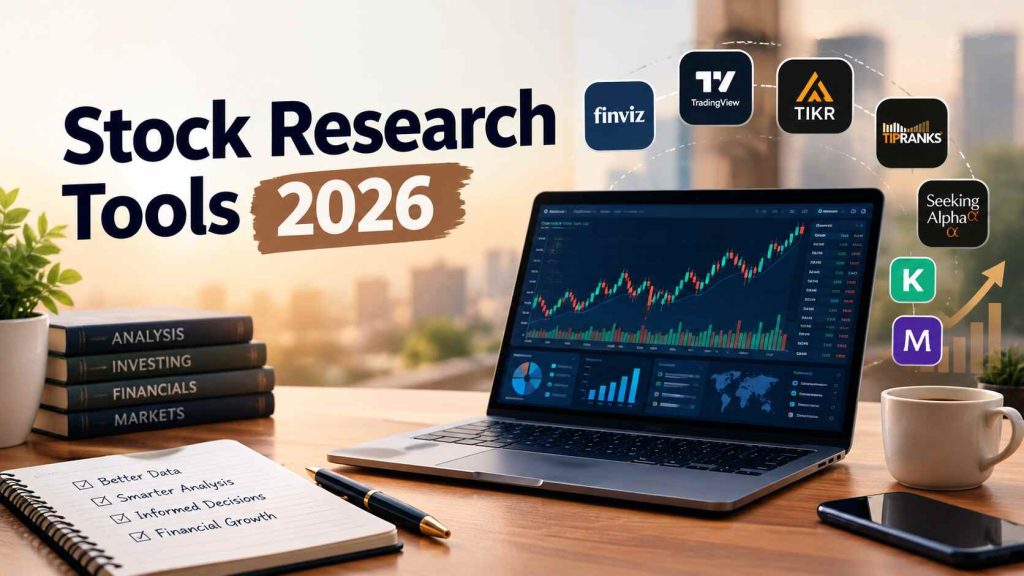
Stock Research Tools 2026 simplify market analysis & stock evaluation. Compare powerful tools for research, insights, screeners, & smarter investing.
What if the biggest reason behind a bad stock pick is not the market, but the information you are using? A stock may look promising on the surface, yet its numbers can tell a very different story. Without solid research, it is easy to overlook warning signs or put money into a company that does not match your goals. Stock Research Tools 2026 bring useful market data, company insights, financial details, and screening features into one place. With the right tools, your investment choices can be based on evidence instead of guesswork.
What are Stock Research Tools?
A stock research tool 2026 is an online platform that assists investors to analyze stocks prior to making investment choices. They collate and present helpful data together, including company earnings, stock prices, valuation information, market news, analyst estimates and historical performance.
There are platforms that specialize in stock screening, and there are those that specialize in charts, financial analysis, valuation and portfolio tracking. Depending on the type of research the investor would like to carry out, the proper tool will be used.
Some platforms also provide capabilities like AI-driven research, sophisticated filters, current alerts, and engaging dashboards in 2026. These features can help facilitate the process of making comparisons among companies and help you reduce your number of stocks to review.
Go this site and also check; ETF Investing Trends 2026
10 Stock Research Tools to Know in 2026
When the market starts to overload with data, the right stock research platform can save time. There are tools that cater to deep company research and others that are dedicated to charts, screening, valuation or market data. Here are 10 Stock Research Tools 2026 that you should be aware of in 2026.
1. TIKR — For Deep Company Research
TIKR is created to suit investors that desire extensive company details within a single location. It provides stock screening across the world, historical financials, valuation tools, analyst estimates, company filings and earnings transcripts. Users can also create their own valuation models and watchlists.
2. TradingView — For Charts and Market Tracking
TradingView is a popular stock research platform that uses charts. TradingView is one of the most popular chart-based stock research platforms. It has charts with interactive features, technical indicators, watch lists, and customizable price alerts. Investors may also contrast monetary measures from more than a single company.
3. Finviz (Quick Stock Screening):
Finviz narrows down the large stock market to a smaller selection of stocks with selected filters. The screener integrates fundamental and technical factors and can be beneficial for screening companies in a short amount of time depending on criteria, sectors, exchanges or other factors.
4. Stock Rover — For Fundamental Screening
Stock Rover is also very much a fundamental and detailed research based company. Users can filter stocks based on hundreds of financial and operational data, compare companies, review historical data and analyze portfolios. Its research reports also combine valuation, growth, quality, dividend and risk information.
5. Koyfin — One place to access Market Data.
Koyfin aggregates company information, market information and economic indicators, charts and watchlists to customizable dashboards. It includes global stocks and offers financials, valuation ratios, analyst estimates, news and other research information.
6. Seeking Alpha — For Investor Research
Seeking Alpha aggregates stock analysis with quantitative information and research from analysts. It has a variety of tools such as Quant Ratings, analyst ratings, stock screeners, portfolio tracking, and market research. It measures the stocks based on various factors, including financial and market indicators, through its Quant system.
7. StockAnalysis.com — For Financial Data
If the primary purpose is to review a company’s financial information, StockAnalysis.com is helpful. It offers income statements, balance sheets, cash flow information, financial ratios, estimates and stock market information. Its portfolio is also international stocks and ETFs.
8. Simply Wall St____ For Visual Stock Research
Simply Wall St: Stocks in a visual presentation. It reports on topics like valuation, growth, financial health, dividends, risks and management. It also offers screening tools to investors who wish to screen the stocks according to certain filters.
9. TipRanks — For Analyst and Insider Data
TipRanks is helpful to investors who are looking to review activity and sentiment of analysts. Its research capabilities allow users to compare analyst ratings, price targets, and any other data pertaining to insiders with other stock data.
10. Morningstar — For Valuation and Fund Research
Morningstar provides research on stocks, ETFs, mutual funds and more. It has a platform featuring screeners, analyst research, fair value information, ratings, comparisons and a watch list. Can be helpful where research is related to individual stocks and investment products as a whole.
For each research task, which tool would you use?
Not all stock research tools 2026 are alike. One might have more powerful financial data, another might have more powerful charting features. Match your research task to a research platform using the following table.
| Research Task | Tools to Consider | Why They Fit |
| Find stocks using filters | Finviz, Stock Rover | Useful for screening stocks based on financial and market data |
| Study company financials | TIKR, StockAnalysis.com | Provides detailed financial statements and historical information |
| Analyze stock charts | TradingView | Offers interactive charts, indicators, and alerts |
| Check analyst ratings | TipRanks, Seeking Alpha | Provides analyst opinions, ratings, and related market data |
| Research global stocks | TIKR, Koyfin | Covers companies and market data across different regions |
| Compare companies | TIKR, Stock Rover | Helps compare financial results, valuation, and other metrics |
| Review dividend stocks | Simply Wall St, Stock Rover | Useful for checking dividend data and company fundamentals |
| Check valuation | TIKR, Morningstar | Provides valuation data and related research information |
| Track stocks regularly | TradingView, Koyfin | Makes regular monitoring easier with watchlists and dashboards |
| Review funds and ETFs | Morningstar, Koyfin | Provides research and data for a wider range of investment products |
Another factor that can determine the best choice is also your method of research. A person who focuses on company financials might require a system various from one who primarily takes a look at price charts. A combination of two to three complementary tools can also help the research process to be organized – but not every task should be performed in one platform.
Free and Paid Stock Research Tools
| Free Tools | Paid Tools |
| Basic stock data | Advanced financial data |
| Simple stock screening | Advanced filters |
| Basic charts and ratios | Detailed analysis and estimates |
| Limited alerts | Custom alerts and monitoring |
| Basic company information | Deeper research features |
| Suitable for occasional research | Suitable for regular, detailed research |
For the basic stock research, free tools are sufficient. If you require more in-depth data, advanced filters or research capabilities, paid platforms might be necessary. The decision will vary between differing levels of stock research and information requirements.
Why is a Stock Research Tool Useful?
Useful Stock Research Tools 2026 should help you to find, compare and track the market. Pay attention to these attributes:
Financial Data / Market Data: The financial data and market data must be from trusted sources.
Enhanced Stock Coverage: Greater choice of markets and companies to research.
Valuable Filters: Good screeners that will be useful in the narrowing of stocks.
Comparing companies side by side: This can help to save time in your research.
Historical Data: Past financial and price information will give background information.
Market alerts: Price, news or market alerts will help you keep an eye on important changes.
Straightforward interface: regular research is quicker and easier due to easy navigation.
It is not always the “best” tool in terms of features that is the most useful. It should be the same as what you really do when conducting stock research.
How to use More Than One Tool
Not all Stock Research Tools 2026 will fit all your needs. Two to three platforms can help make it more flexible.
You can use the filters to shortlist stocks from any source, such as Finviz. Next, use TIKR to analyze financial data, valuation, and history. You can use TradingView to examine price charts, and TipRanks to get more insights from analysts and insiders.
The trick is to assign a particular function to each platform. Too many tools are a research conundrum.
One possible process is:
Review other data → Analyze charts → Review finances → Check screen stocks → Make your own stock assessment
This way, the stock research is kept tidy and not relying on any one site.
Mistakes to Avoid
While Stock Research Tools 2026 can be helpful, they shouldn’t be used in place of thorough analysis. Here are some of the most common errors to avoid:
Following Ratings Blindly: Don’t just go with a high rating: A stock’s performance is not always determined by its rating.
Using One Metric: All of these measures will not give the whole picture: using one of the metrics alone will not provide the full picture.
Not updating Data: Outdated financial data might provide a partial picture of a business.
AI Only vs. reliable financial sources: Only use AI generated research and verify it against the reliable financial sources.
Too Many Tools: When there are too many tools, research can be slower and more difficult to manage.
The stock screener will be able to narrow down the list, but company research is still important.
Final Thoughts
Stock Research Tools 2026 can help streamline stock analysis, making it more organized and efficient. Each platform serves a specific purpose: screening and financial research, charting and analyst data.
Rather than relying on a specific tool, investors can select platforms that align with their research approach. The important thing to remember is to rely on accurate information, compare information thoroughly, and make decisions after conducting thorough research.
FAQs
Q1- Can stock research tools be used by long term investors?
Yes. They can assist with the analysis of the performance of a company, the changes in its financial status, the valuation of its business, and the development of the business in the long term.
Q2 – Can stock research tools help with international stocks?
Yes. Certain platforms offer trading of firms and markets outside of the U.S. and could be beneficial for overseas stock analysis.
Q3- Is the stock research tools giving a real time price of the stocks?
There are some real-time or near-real-time data providers, and others may have delayed prices depending on their plan and data provider.
Q4- Do Stock Research Tools 2026 reflect the earnings of companies?
Yes. There are a few sites that offer information on earnings dates, financial statements, estimates and other company updates.
Q5: Can stock research tools be beneficial to the dividend investor?
Yes. Others offer dividend-related details such as dividend history, yields, payout information, and more to aid in dividend research.
Q6- can stock research tools that can be used to compare competitors?
Yes. There are several sites that enable investors to compare a company’s financial results, valuation ratios, growth figures and other metrics.
Q7- Are there any Stock Research Tools 2026 available for ETFs?
Some will include ETFs as well as individual stocks. Some of the data and research tools available may differ across platforms.

Pingback: Active ETFs vs Passive ETFs: What Sets Them Apart in 2026