
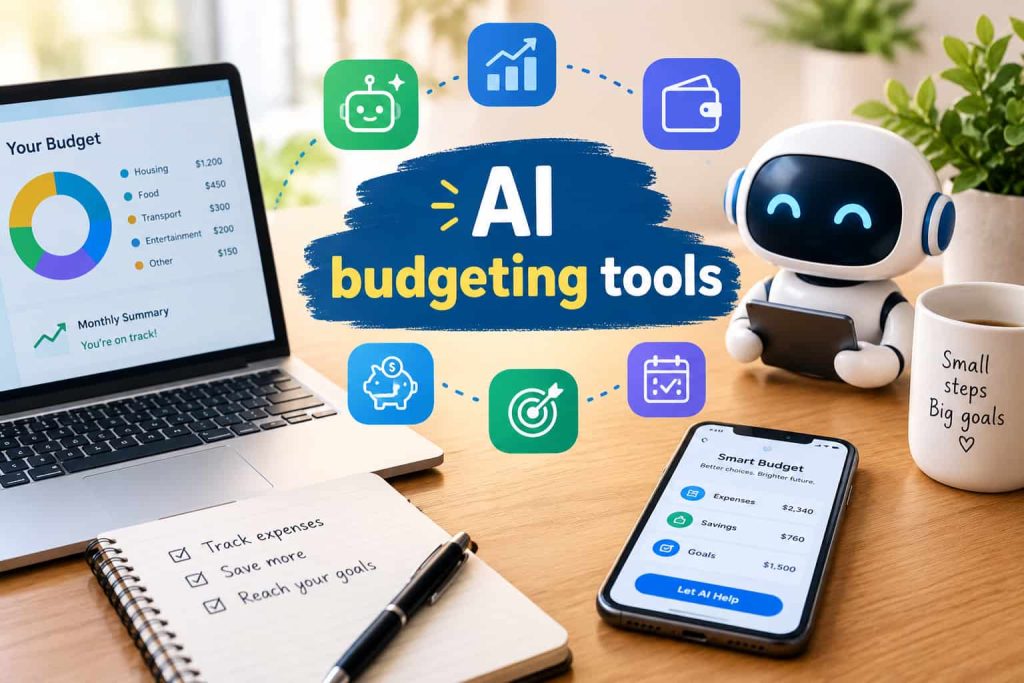
AI Budgeting Tools 2026 help you track spending, manage bills, and spot savings opportunities. Compare smart features to boost your savings every month.
Monthly don’t know where your money went and always have trouble keeping track of your finances? It’s not easy to do without a plan to pay bills on budget and save money. AI Budgeting Tools can analyze your spending habits and organize your finances, making it easier. They can assist you in making sensible budgets, monitoring your spending and enhancing your awareness of how much you can save. In 2026, you can be more informed about your finances and better manage the money with the right tool.
AI Budgeting Tools
AI Budgeting Tools are digital tools that use AI to assist individuals in budgeting. They monitor their expenditure, classify their spending, follow bills and spot their spending patterns. This will aid you to have better budgeting throughout the month. There are some tools which are attached with bank accounts and credit cards and others where the expenses are entered by hand. They can identify frivolous spending, alert the user of budget, and assist the user in making realistic savings targets.
For instance, a grocery costing app or shopping app could be telling you that you should spend more on groceries or shopping, and this AI application may learn this trend and suggest how much you can save. Other tools forecast and monitor what money will be spent on and progress toward financial objectives. However, apps don’t all have the same features. Some will be the simplest to provide details regarding your spending, some may even be able to give you custom details and even suggestions. The best way to use AI Budgeting Tools is to consult them and then tailor your budget to meet your requirements.
For Further Visit : lessinvest
Go for also: investment options in the US
The top AI budgeting tools for the year of 2026.
The best AI budgeting software will help you to track your spending, review your subscription activity and make smart spending choices. However, each of the apps serves a different purpose. Some are more specific on budgeting, others more on automation of insights or money management on a day-to-day basis.
When selecting a tool, take into account features, subscription charges, bank compatibility and privacy features. Make a chart that compares/contrasts these 6 options.
1. Monarch Money
- AI-powered financial insights
- Kept up to date to track spending and budgetary costs.
- Cash flow analysis
- Weekly financial summaries
2. Cleo
- Generate an AI assistant to create a budget plan using chat.
- Spending habit analysis
- Keeping an eye on and organizing costs (in mobile / online)
- Budgeting support
3. Rocket Money
- Subscription tracking
- Recurring payment monitoring
- Monthly expense analysis
- Rowan is an advanced financial assistant (AI).
4. YNAB
YNAB is made for anybody who likes a “by-the-numbers” method to budgeting. Rather than all of the suggested actions going through the automation process, the users give their incomes as top priority, followed by their expenses, savings, and future bills. Not an AI budgeting app but it can help users develop a habit of budgeting their finances on a regular basis.
5. Quicken Simplifi
Quicken Simplifi brings together spending tracking, bill monitoring and saving goals and cash flow planning. If they have budgeted items, It’s Spending Plan enables them to see what money is available in their budget. It’s the sensible option for those who wish to get a handle on their monthly finances.
6. Origin
Origin is a combination of budgeting and financial planning in general. It also features an AI Budget Builder that can do analysis on your income and expenses and provide you a budget based on information about you. You can set the budget and saving goals according to your financial requirements.
Benefits of AI Budgeting Tools for saving money
AI Budgeting Tools can help with the day-to-day aspects of budgeting, and of course, save you money. There is no need to follow every single deal; it’s necessary to get better monetary choices with automated insights.
1. Identify Unnecessary Spending
AI Budgeting Tools categorize the transactions and pinpoint potentially budget overruns. You may be financially spending a lot of money on food every month by ordering food regularly, or buying items you don’t need. Having a good understanding of these trends can help you to gauge where to make cuts.
2. A bill and subscription management system
The costs of your subscriptions can add up quickly, and you may not know you have an unclaimed subscription. Some budgeting apps recognize these payments and provide alerts prior to payments being due. Information about any charges and cancel services you don’t need.
3. Set Realistic Savings Goals
These instruments can assist you establish objectives for emergencies, holidays or big-ticket items. After analysing your income and expenses, they can better help you to calculate how much you can save per month without falling behind on any payments.
4. Monitor Your Spending in Real Time
AI budgeting tools will include budgeting alerts and new budgeting summary. You could get a message if you’ve reached your monthly spending cap. This will give you an opportunity to make some fine tuning of your spending habit ahead of your budget being broken.
5. Plan for Upcoming Expenses
Some of the apps deal with cash flow that is recurring and makes a prediction of future cash flow. This can assist you in budgeting for rent, utilities, insurance and more. However, predictions are not infallible, so it is advisable to check predictions prior to investment.
6. Manage personal finances
AI can identify trends and patterns that might not be immediately apparent. As you may notice, your bills begin to pile up or bills may be increasing towards the end of the month. These can be utilized as time goes on to establish good spending habits.
The main goal is to remain consistent! AI budgeting tools can identify savings opportunities, but they’re not guaranteed and only will occur if you’re engaged in your budget review and make the appropriate decisions.
Key Features to Check Before Choosing a Tool
Each of the AI Budgeting Tools offered can provide different features. Some highlight the tracking of expenses; others offer customized information and also offer suggestions on exactly how to save money. These are some of the most crucial properties that you should consider when choosing an application.
- Auto categorize transactions: The application should be able to auto categorize the transactions, for e.g. grocery, rent, transport, entertainment, etc.
- AI Spending Insights: Seek out tools that can determine the spending habits and offer practical tips on managing finances.
- Bill Reminders: Setting up reminders to pay bills on time can prevent you from paying late and having to pay late fees.
- Saving Goals: If there is an application that you can create some saving goals, for travel, a big purchase or funds.
- Bank Account Integration: Make sure that it integrates with your bank account and has a secure method of connecting to it.
- Subscription Tracking: It can be employed to discover recurring payments and services that may not be required.
- Privacy and Security: Check before providing financial information the data policies and security, as well as permissions to the app.
- Subscription rates and Free Functionality: Decide its rate and functionality which you want to be available in the subscription that you are using. If you’re only in need of a simple budget plan, a free budget plan may be enough.
This will actually rely upon your financial practices. Concentrate on the features that will suit your budgeting requirements, instead of “fancy” features that you don’t utilize.
Free vs Paid AI Budgeting Tools
| Features | Free AI Budgeting Tools | Paid AI Budgeting Tools |
| Expense Tracking | Basic transaction tracking | Detailed expense analysis |
| Budgeting | Simple spending limits | Advanced budget planning |
| AI Insights | Limited or basic insights | Personalized financial analysis |
| Spending Reports | Basic monthly summaries | Detailed financial reports |
| Savings Goals | Basic goal tracking | Additional planning features |
| Subscription Tracking | May have limited features | Extended subscription management |
| Account Connections | May have restrictions | Usually offers more connections |
| Cost | No subscription fee | Monthly or annual subscription |
| Best For | Beginners and basic budgeting | Users needing advanced features |
So, which one is it you need to opt for? For anyone keeping an eye on their spending, Free AI Budgeting Tools will be a beneficial start. Paid plans may be worthwhile if the extra features are ones that you require. Before subscribing always make sure to find out the latest pricing and plan limits.
How to Use AI Budgeting Tools Effectively
AI Budgeting Tools are simpler to use if you’ll have a routine for using them. The steps you can take in your financial planning can help you make the best choices regarding spending.
Review Your Income and Expenses: See income and expenditure by linking financial accounts (if it is comfortable for you) or by entering the transactions manually. Review your monthly income, bills and expenses to gain a better handle on your finances.
Create a budget: Create a food, housing, transportation, entertainment and other costs budget. Don’t make unrealistic goals; set limits in accordance with your income.
Make specific saving goals: have a goal that you think is important, such as an emergency fund, vacation or a significant purchase. Determine a budget and schedule that is feasible.
Check AI Spending Recommendations: See the recommendations for spending and saving by artificial intelligence. Don’t take their advice lightly and confirm and check anything unusual that they make.
Monitor your spending on a weekly basis: Spending Alerts, upcoming bills and balances. A few tweaks can be made throughout the month that can prevent any overspending.
Make monthly budget adjustments: Make comparisons between your budgeted and actual spending. Modify limits on time when income and expenditure level or priorities in finances change.
Tip: AI Budgeting Tools are not budgeting tools for you, but rather a tool that can assist you in the budgeting process. An often reviewed budget with goals that can be achieved assists chances of success in the long run.
Limitations of AI Budgeting Tools
- Misclassification: If there are any issues when matching the categories of the transactions with the AI classification, then there will be issues.
- Financial Information Risks: This could result in the disclosure of financial information, if it is not adequately secured.
- Premium subscription fees: Expense may be lowered with premium subscriptions.
- Limited Bank Support: There are limited banks that some apps can be used for.
- Unexpected costs can impact forecasts: inaccurate predictions.
- Using AI: AI suggestions might not be suitable for you.
Final Thoughts
AI Budgeting Tools can make managing your finances smoother, by tracking your spending habits, and creating realistic savings goals. The best app will be based on your financial goals, features that you are looking for and budget.
Take into account the costs, privacy and features of a tool when making your choice. A free solution may be a better choice if you want to monitor your spending, but don’t necessarily need all the bells and whistles. An AI Budgeting Tool can help you develop a more efficient financial plan and reach your savings goals for 2026 by regularly auditing your budget and making savvy budgeting decisions.
FAQS About AI Budgeting Tools
Q1. Does AI budgeting software work with non-standard income?
Yes, there are tools to do that which would enable you to set budgets according to changes in income. They have the capacity to be used by the freelancer to make crucial costs and get ready for months of less successful profits.
Q2. Is it possible for financial advisor apps to be replaced by AI apps?
These tools can assist you with everyday financial activities, and are not intended as a substitute for professional advice for more complex financial activities, investments or tax planning.
Q3. Are students able to make use of AI budgeting tools?
Yes, they can be used to help students keep a record of their allowances, part-time jobs, tuition, expenditures on a daily basis, and socialize them into good money management habits.
Q4. What are some drawbacks of budgeting tools that are available in AI outside the USA?
This is dependent on the country but some do. Please know what is offered in your area, if your bank does offer the application, what banks they have and what the cost of the subscription is before signing up.
Q5. What are the ways in which AI budgeting tools can help with a couple’s finances?
While this isn’t always possible, there are times when the apps are able to share a common budget and keep record of joint expenditures. Couples can keep track of the costs on the home, share bills and set shared savings goals.


Pingback: How to Invest in The Stock Exchange: Smart Tips for 2026